
The Container Communicates Before the Content Begins
Creator exemplars across every attention mode, and the production principle each one proves.
Before we built the Welcome to the Lab studio at Microchip Technology, I watched a collaboration video between Make Art Now and Gerald Undone.
Both are YouTube creators who work at the intersection of technology, craft, and visual storytelling. The video moved between their studios, showing the spaces where they work and the environments they have built around the act of making things. I wasn't watching as a viewer but as a producer, trying to understand why certain content environments make you trust the person speaking before they have said a single word worth trusting.
What I was looking at was passive personality and functional information held in the same frame. Knick-knacks that said I do what I say I do. The obvious tools of someone who actually does this kind of work, arranged not for decoration but for the eye to discover, so it could pan around the frame and find something new each time. A dimmer lighting scheme with pops of color gave the frame a gestalt, leading the eye and the mind on a journey of discovery that lent authority to the content before the content had earned it through substance alone.
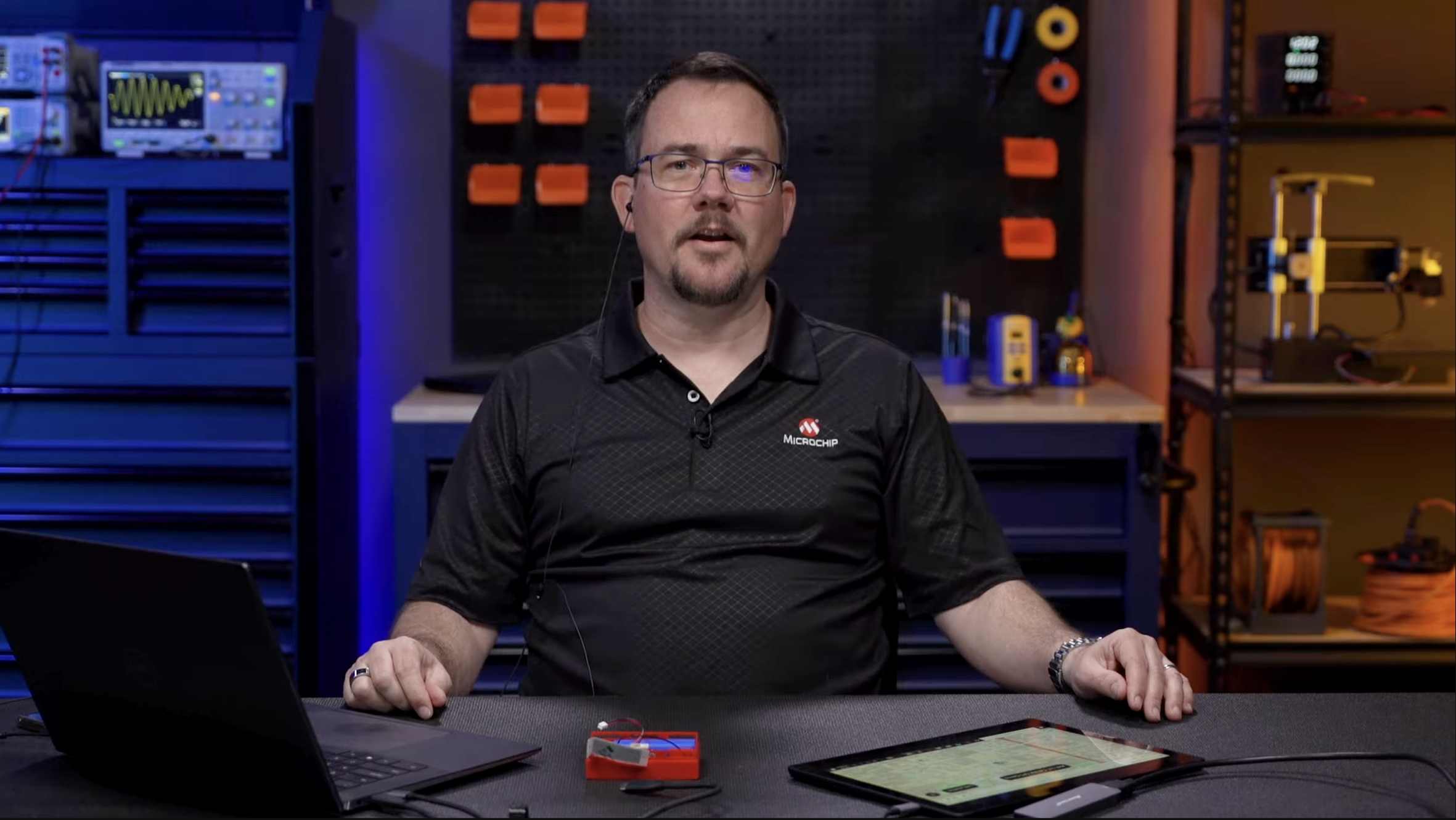
That was the studio we built. Blue and orange lighting to match the brand. Blue toolboxes chosen deliberately to evoke the gravity of a craftsman working in a sacred space where tinkering is the first step toward innovation. Oscilloscopes, soldering tools, an old 3D printer donated by one of the engineering teams, Pelican cases for visual weight, a microscope for curiosity, and a pegboard on the wall for tools and electrical tape. Every element was lit and placed to create the panoramic effect, the gestalt that made the eye move without being directed to.
The studio wasn't a backdrop. It was a Skimmer hook built into a Diver environment. The visual environment did the work of the thumbnail, and then the depth of the knowledge did the work of retention. Before Ross Satchell said a word about the GPS tracker he had built, the viewer already trusted the space he was standing in.
That is what the best exemplars in every audience mode have figured out. The container communicates before the content begins.
What an exemplar actually teaches you
Before the examples, a framing that matters.
The purpose of studying creator exemplars is not to imitate them. It is to understand what problem they have solved that you haven't, and to extract the production principle behind the solution rather than the aesthetic surface of it.
Make Art Now and Gerald Undone solved the authority problem in Diver content. The studio environment communicates competence before the creator has to prove it. That is a production principle: design the environment to do pre-cognitive credibility work, so the content can spend its time on knowledge rather than persuasion.
Every exemplar below solves a specific production problem for a specific audience mode. The lesson is the principle, not the format.
Skimmers: The visual identity exemplars
National Geographic (285 million Instagram followers)
The benchmark for Skimmer-level brand identity is not a brand. It is a publisher. National Geographic has built a visual language so consistent and so distinctive that the brand is recognizable at thumbnail size, before any logo or caption is visible. Every image is a brand statement, signaling the same values of wonder, precision, and the natural world as subject without requiring the viewer to read anything.
The production principle: visual coherence at scale is less a style guide than a training program. Every photographer who shoots for National Geographic has internalized a set of aesthetic values so thoroughly that the output stays consistent across thousands of contributors, dozens of languages, and a century of publication. The brand is the trained eye, not the logo.
For an organization building decentralized content infrastructure, this is the standard. When content is produced across many studio nodes, operators, and locations, the visual output should still be recognizable as coming from the same institution regardless of who made it. That requires training, not just guidelines.
Humans of New York (22 million Instagram followers)
Brandon Stanton's work proves something more specific: a single photograph with a caption can carry the full weight of a human narrative. One image and one caption, with no video, no motion, and no production beyond the quality of attention Stanton brings to the frame and the trust he earns from his subjects.
The production principle: Skimmer content that stops the scroll doesn't need to be complex, it needs to be specific. What stops people on Humans of New York is not production value but the specificity of the human it captures, a particular face and an unrepeatable expression attached to a story no one else could have told.
For university photography programs, this is the model that most institutional photography ignores. Campus event photography captures the general where Stanton captures the specific, and the difference in scroll-stopping power is not marginal but categorical.
University of Michigan (523,000 Instagram followers)
The higher education benchmark for visual brand consistency. The Michigan Instagram feed reads as brand before you see a logo. Every image feels unmistakably Michigan, not because it carries obvious markers but because the aesthetic values are consistent enough that the institution is recognizable across contexts.
The production principle: visual brand is a standard applied consistently at volume, not a campaign applied occasionally at scale. Michigan's Instagram works because someone is making editorial decisions with a coherent visual philosophy behind them, not because the photography is technically superior.
Swimmers: The authentic voice exemplars
University of South Carolina
The data point that should reorganize how any university thinks about short-form content: South Carolina has held the number one engagement position among Division I schools on TikTok for two consecutive years. In the 2025 RivalIQ Higher Education Social Media Engagement Report, they recorded 1.9 million total engagements at a 12.84 percent engagement rate, nearly three times the higher education average.
The production principle is not what most people assume. South Carolina didn't build a TikTok strategy by hiring a social media team to produce polished content. They won by capturing authentic student and mascot moments that were unscripted, unpolished, and genuinely human. The content performs because it carries the signal Swimmer audiences are calibrated to detect: this is real.
The lesson for any organization building a Swimmer content program is that production investment and Swimmer performance have an inverse relationship beyond a certain threshold. Once the content is clear and audible, additional polish starts to work against you. The authentic human signal degrades in proportion to the production layer applied on top of it.
Adam Ragusea
The creator who most clearly operationalizes authentic presence in service of a subject. His food science videos are filmed in his own kitchen, talking to the camera without the gloss of a formal studio, and every one of them is about the how and why of cooking rather than about him. The unpolished delivery is the point, not a limitation.
The production principle: Swimmer content is not unproduced; it is produced to feel unproduced. The difference between authentic content and sloppy content is intentionality: knowing exactly what the audience needs to feel to trust you, and building the environment that creates that feeling reliably. Ragusea's videos feel casual and effortless, but the framing, the pacing, and the way each explanation is structured are deliberate. The casualness is a decision.
For any organization whose experts know their subject cold, this is the model worth studying. Not the specific format, but the principle: put a real person on camera to serve the topic, and let intentional authenticity do the work that polish cannot.
Charlie Engelman
Over four billion TikTok views as a science communicator. The subject matter of biology, ecology, and unusual animal specimens is not intrinsically viral. What Engelman has built is a format that opens the curiosity gap in the first three seconds and then closes it with information that is specific, surprising, and memorable. Every video delivers a nameable insight the viewer didn't have before pressing play.
The production principle: Swimmer content doesn't have to be shallow to be short. Engelman proves that complex, substantive content can hold a Swimmer audience when the entry frame is human, curious, and surprising enough. The format is accessible. The knowledge is not.
For organizations that believe their subject matter is too complex for short-form content, Engelman is the existence proof that the complexity is not the problem. The entry frame is the problem.
Divers: The depth exemplars
Make Art Now and Gerald Undone
The exemplars that built the Welcome to the Lab studio. What Make Art Now and Gerald Undone have each figured out, and what their collaboration made explicit, is that the environment is the pre-hook. The studio communicates before the creator speaks. The tools on the wall, the layered background, and the lighting that leads the eye around the frame are all doing credibility work that would otherwise fall to the content itself.
Gerald Undone's Studios Undone series takes this as its entire premise, infiltrating the workspaces of other creators to understand what a studio reveals about the person. The studio is a portrait. What it contains, how it is lit, and how it is organized all communicate something about the creator's relationship to their craft before the camera cuts to them speaking.
The production principle: in Diver content, the environment is not set dressing; it is evidence. Design it to communicate what the creator knows, what they value, and the kind of work they do, passively, before the content begins.
Stanford GSB
The institutional Diver benchmark. Named series architecture, including View From The Top, Quick Study, In Class Takeaways, Changemakers, and Explainer, each designed for a different depth of viewer commitment within the Diver mode. The content functions as a branded editorial channel rather than a repository. Every series holds a consistent format, host posture, and value proposition for the viewer.
The production principle: Diver content at institutional scale requires editorial architecture, not just production quality. A flagship video is not enough. A series with a consistent format, perspective, and promise to the viewer is what builds the returning audience that Diver content depends on.
MIT OpenCourseWare (5.72 million subscribers, 485 million views)
The largest .edu YouTube channel in the world. Full courses, lectures, and faculty knowledge, free and open and organized for the viewer who has decided to invest serious time in understanding something. MIT OCW does not optimize for casual discovery. It is built for the viewer who already knows they want to go deep.
The production principle: not all Diver content needs to be cinematic. MIT OCW is produced simply, a professor with a whiteboard and a camera. What makes it work is the depth of the knowledge and the way the content is organized around how a learner actually moves through a subject. The production serves the pedagogy, and the pedagogy is the product.
Mark Rober and Veritasium
Already established in the Technology track of this series as the gold standard for Diver content that also converts Swimmers. The production principle worth restating here: the best Diver content doesn't begin with the depth. It begins with a curiosity gap that a Swimmer would stop for, and then earns the depth by delivering an insight the Swimmer didn't know they needed.
This is the dual-mode function the Welcome to the Lab studio was designed to achieve: a visual environment compelling enough to stop a Skimmer, an authentic human presence credible enough to hold a Swimmer, and a depth of knowledge substantial enough to satisfy a Diver. Three modes served by one production environment, and one creator who knows the material the way a craftsman knows their tools.
The production principle that runs through all of them
Every exemplar above has solved a version of the same problem: how do you signal to the right audience mode that this content is for them, before they have committed enough time to verify it through the content itself?
The Skimmer exemplars signal through visual coherence, so the brand is recognizable before a word is read. The Swimmer exemplars signal through authentic presence, so the human reads as real before the topic is even established. The Diver exemplars signal through environmental evidence, so the creator looks like they know the subject before they open their mouth.
In each case, the signal is pre-cognitive, operating before conscious evaluation begins. And in each case it is built into the production environment, into the aesthetic choices and the physical space and the visual language, rather than into the content itself.
This is why the production model matters. The content can be excellent and still fail to reach the right audience if the production environment is sending the wrong signal. An engineer with extraordinary knowledge, recorded in a conference room under fluorescent lights on a laptop camera, is sending Skimmer and Swimmer audiences a signal that says leave. The knowledge doesn't get a chance to do its work.
The Welcome to the Lab studio was built to solve that problem. The blue toolboxes, the oscilloscopes, the 3D printer, the microscope, the pegboard, and the brand-colored lighting were all chosen to send a signal to a Diver audience before Ross Satchell said a word: this is a place where real technical work happens, and the person standing here knows something worth your time.
That signal is a production decision. It is not a content decision.
The next post in this series gives that pre-cognitive signal a name. It introduces two concepts, the Wandering Eye and the Panoramic Signal, and the production framework behind why certain content environments earn authority before a word is spoken.
Clarity Is the Product is a series by Lumen8 Media on how organizations translate complex ideas into scalable understanding. The next post introduces the Wandering Eye and the Panoramic Signal, the production framework behind why certain content environments earn trust before a word is spoken. Read the full series at lumen8.media.
