
The Panoramic Signal: How to Design a Content Environment That Earns Trust Before You Say a Word
What a viewer's eye does before the content starts, and how to design a frame that rewards it.
There is a moment, when you watch content made by someone who truly knows their craft, where your eye begins to move.
Not toward the speaker. Around the frame. Behind them, beside them, into the corners of the space they occupy. You are not doing this consciously. You are doing it because the environment is designed to reward that movement, because there is something to find in every direction, and finding it tells you something important about the person at the center of the frame before they have said anything worth evaluating.
You are experiencing what I have come to call the Wandering Eye.
It happened to me the first time I watched a collaboration between Make Art Now and Gerald Undone. Two YouTube creators, both working at the intersection of technology and craft, touring each other's studios. I was not watching as a viewer. I was watching as a producer with a problem to solve: how do you build an environment that makes an engineer's technical knowledge feel authoritative to a global developer audience before the engineer opens their mouth?
What I saw in that video was the answer. Not as a technique to imitate. As a principle to extract.
Two concepts. One production framework.
The Wandering Eye is what happens to an audience when a content environment is designed correctly. It is the pre-cognitive behavior of a viewer whose eye moves around the frame not because they have been directed to but because the frame rewards exploration. It is the audience's half-conscious recognition that this space contains more than the speaker, that the environment itself is communicating something worth reading.
The Wandering Eye is not a trick. It cannot be manufactured by adding more objects to a background. It emerges from a specific quality of intentional curation, from environments that have been designed so that every visible element carries information the viewer can decode. Tools that are actually used. Equipment that is actually functional. Objects that reveal something true about the person working among them.
The Panoramic Signal is the production strategy that generates the Wandering Eye. It is the deliberate design of a content environment so that the frame communicates in all directions, not just straight ahead, and what it communicates, before a word is spoken, is this: the person here knows what they are doing.
The Panoramic Signal is pre-cognitive. It operates below the threshold of conscious evaluation. A viewer who experiences a well-designed Panoramic Signal does not think I trust this person because of the equipment on the shelves behind them. They simply trust. The reasoning comes later, if at all. The signal has already done its work.
The principle behind the principle
There is a reason this matters more now than it did a decade ago.
The Skimmer-Swimmer-Diver framework established in the previous post describes audiences operating across three radically different attention modes. Skimmers decide in the thumbnail. Swimmers decide in the first fifteen to forty-five seconds. Divers have already committed, but they are also the most discerning, the most calibrated to detect inauthenticity, the most likely to abandon content that fails to deliver the depth they came for.
The Panoramic Signal is primarily a Diver tool. But it works differently across all three modes.
For Skimmers, the Panoramic Signal operates at the thumbnail level. The first frame of a video, the cover image of a carousel, the visual environment visible before play is pressed, these are the moments where the pre-cognitive signal is either transmitted or lost. A thumbnail that shows a distinctive, purpose-built environment sends a different signal than a thumbnail that shows a person standing in front of a white wall. Neither requires the viewer to think. The Wandering Eye begins before they press play.
For Swimmers, the Panoramic Signal operates in the first fifteen seconds. The camera reveals the environment before the host has said anything substantive. The eye moves. The viewer makes a pre-conscious assessment: is this space interesting? Does it contain something worth staying for? The Swimmer who experiences the Wandering Eye in the first fifteen seconds is already more likely to give the content thirty seconds. And thirty seconds is enough to convert a Swimmer into a Diver if the content delivers.
For Divers, the Panoramic Signal operates throughout the entire piece. Every cut to a different angle reveals more of the environment. Every close-up of equipment at work reinforces the signal. The studio is not set dressing. It is ongoing evidence, a continuous argument for the authority of the person at the center of the frame.
Building the Welcome to the Lab studio
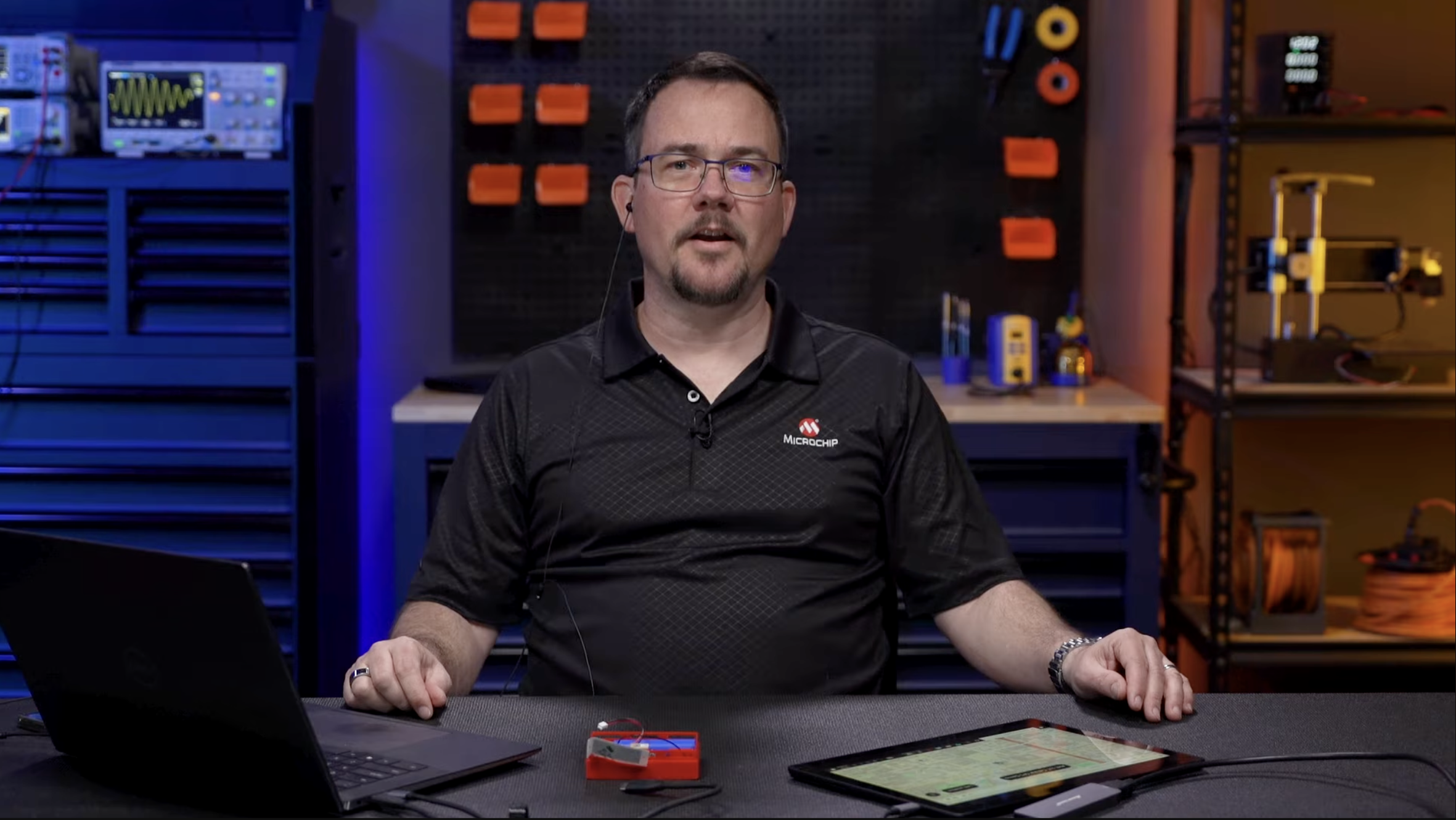
When we built the studio for the Welcome to the Lab series at Microchip Technology, we were designing a Panoramic Signal for a specific audience: electrical engineers and software developers who were evaluating, in the first seconds of any video, whether the person on screen actually knew what they were talking about.
This is a demanding audience. Engineers are trained to detect false expertise. They have encountered enough confident-sounding incompetence in their careers to have developed highly refined filters for it. A studio that looks like a television set, bright, formal, designed for broadcast, sends the wrong signal to this audience immediately. It communicates performance, not knowledge. It says this content was made by someone who thinks about how it looks, not someone who thinks about what it contains.
We needed the opposite signal.
We started with lighting, blue and orange, matching the Microchip brand. Not because branded lighting is always the right choice, but because in this case the color palette served two functions simultaneously: it communicated brand identity passively, in every frame, without requiring any explicit branding element, and it created the pops of color that give a dimmer, more atmospheric environment its visual depth. Flat lighting kills the Wandering Eye. Directional, colored lighting creates the shadow and contrast that give the eye something to move through.
We chose blue toolboxes deliberately. Not because toolboxes are decorative. Because toolboxes communicate a specific thing about the person who works near them: that they work with their hands, that they build and fix and iterate, that this is a space where tinkering is the first step toward something real. For an electrical engineering audience, a toolbox is a credential. It says I do what I say I do before the speaker does.
We added oscilloscopes and soldering tools, functional equipment that an electrical engineer would recognize and use. A microscope for curiosity. An old 3D printer donated by one of the engineering teams, its donated status making it more authentic rather than less. Pelican cases for visual weight. A pegboard on the wall for tools and electrical tape. Every element was real. Every element was functional. Every element communicated something decodable to the audience we were trying to reach.
The result was a frame the eye wanted to explore. Not because we had filled it with interesting objects, but because we had filled it with meaningful ones, objects that carried information the viewer could read, arranged so that reading them rewarded the act of looking.
Before Ross Satchell said a single word about the GPS tracker he had built, the viewer who watched the first fifteen seconds of that video already knew they were watching someone who understood the material. The studio had told them. The Panoramic Signal had done its work.
The three-question diagnostic
The Panoramic Signal is not a formula. There is no checklist of objects that generates a Wandering Eye. The principle is about intentionality and legibility, every element in the frame should be there for a reason the audience can decode, even if they never consciously decode it.
These three questions can help any content producer evaluate whether their environment is generating a Wandering Eye or a blank stare.
One: When someone lands on your content environment for the first time, before pressing play, before reading a caption, what does the eye do? Does it wander and discover, or does it find nothing to hold it?
The honest answer to this question requires watching your own content the way a new viewer would. Not evaluating the content. Watching the frame. If the eye has nowhere to go except straight ahead to the speaker, the Panoramic Signal is not present. The environment is a backdrop, not an argument.
Two: Could this environment belong to anyone, or does it communicate something specific about who made it and what they know?
A generic studio, clean, bright, neutral, fails this question by definition. The Wandering Eye requires specificity. The objects in the frame should tell a story that only this creator could tell. The Welcome to the Lab studio communicated electrical engineering, brand identity, and the specific culture of tinkering and iteration, none of which could have been communicated by a generic professional background.
Three: Is the visual signal reaching the right audience mode, Skimmer coherence, Swimmer authenticity, or Diver credibility, before the content has to earn it?
This is the most strategic question. The Panoramic Signal should be calibrated to the audience mode the content is designed to serve. Skimmer environments need visual coherence and instant recognizability. Swimmer environments need the markers of authentic human presence, the slightly imperfect, the genuinely personal. Diver environments need the evidence of real expertise, the functional tools, the working equipment, the space that looks like something actually happens there.
Building a Diver environment with Skimmer aesthetics, clean, branded, visually controlled, sends a signal that conflicts with what Diver audiences are looking for. Building a Swimmer environment with Diver aesthetics, complex, layered, expertise-dense, can intimidate the very audience it's trying to hold.
The Panoramic Signal has to know who it's talking to.
Where the concept extends
The Wandering Eye and the Panoramic Signal are not studio concepts. They are production concepts that apply wherever a visual environment precedes a content evaluation.
A LinkedIn carousel cover slide is a Panoramic Signal. It communicates something about the creator before the viewer swipes to the content. A thumbnail is a Panoramic Signal. A podcast cover image is a Panoramic Signal. The visual aesthetic of an Instagram grid is a Panoramic Signal, one that operates across dozens of images simultaneously, creating a Wandering Eye at the profile level before a single post is opened.
The principle is the same in every context: the environment communicates before the content begins. Design it deliberately. Make every visible element legible. Give the eye something worth finding.
The next post in this series takes the Panoramic Signal into its most extreme context, a platform where the environment is the content, and the signal has to hold an audience not for fifteen minutes but for hours at a time. What a college campus, a Twitch stream, and 23 million hours of viewing tell us about the future of institutional live content.
Clarity Is the Product is a series by Lumen8 Media on how organizations translate complex ideas into scalable understanding. The Panoramic Signal and The Wandering Eye are original frameworks developed by Lumen8 Media. Read the full series at lumen8.media.
