
The Role That Doesn't Exist at Most Universities
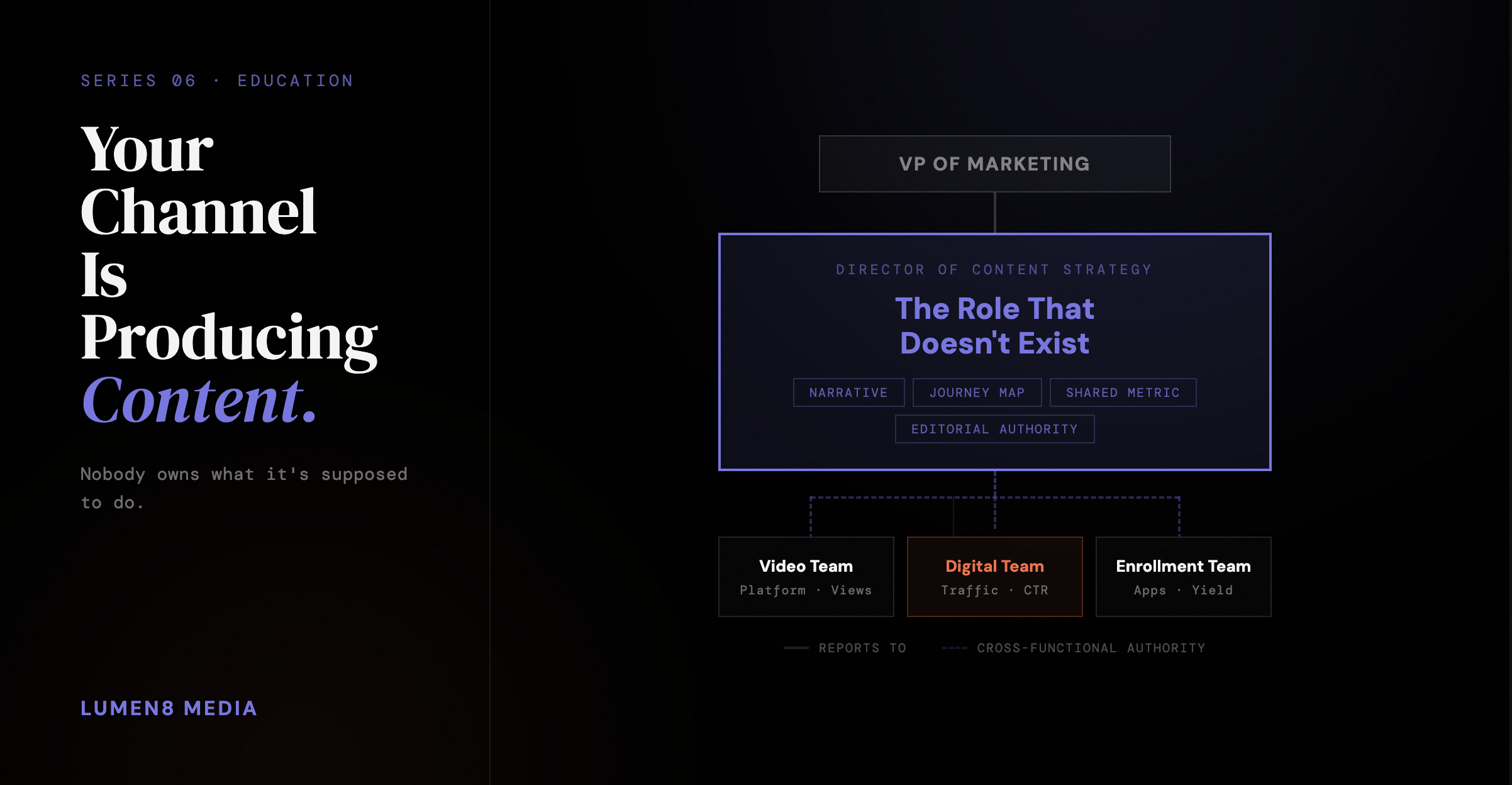
And why its absence explains more about your channel's underperformance than anything in your analytics dashboard.
If you're joining mid-series: Post 03 (Most University YouTube Channels Are Expensive Brochures) established why the problem isn't production quality… Post 04 ( Your University’s YouTube Channel is Working, You Just Can’t Prove it) reframed what "working" means… Post 05 (ASU Got Closer to Solving University YouTube Than Anyone. The Gap Is Still Open.) traced what happens when an institution actually tries to close the gap. This post is about the organizational reason why, and what it would take to fix it.
There is a conversation happening in university marketing departments across the country that goes roughly like this:
The VP of Marketing presents the YouTube analytics to the enrollment leadership team. Views are up. Watch time is trending in the right direction. The brand awareness study shows familiarity scores improving among the target demographic. Someone asks: "Can we show how this connects to applications?" The VP says they're working on the attribution model. The conversation moves on. The channel keeps producing content. The question doesn't get answered.
The conversation isn't really about data, or technology, or content quality, or posting frequency, or whether you're on the right platform. It's about the absence of a single function inside the institution, a function most universities don't have a name for, let alone a job description or a budget line. Until that function exists, no analytics dashboard, no attribution tool, and no content calendar will close the gap between "video influenced 80% of application decisions" and "here's the enrollment revenue we can trace to our channel."
The organizational map of a content gap
To understand why the function is missing, you have to look at how the work is currently divided.
At most universities, three separate teams touch the student decision journey through video and digital content, and they share almost nothing.
The video or creative team produces content. Their success metrics are production output, view counts, watch time, and subscriber growth. They are rewarded for making content that performs on platform. They are not accountable for what happens after the video ends.
The digital marketing team manages distribution. Their success metrics are website traffic, click-through rates, campaign performance, and platform analytics. They are rewarded for efficiently moving audiences from one digital touchpoint to the next. They are not accountable for whether the content those audiences consumed actually answered the question that would have moved a student toward a visit, an inquiry, or an application.
The enrollment team owns the pipeline. Their success metrics are inquiries, campus visits, applications, admits, and yield. They are rewarded for moving students through the funnel. They are not accountable, and often have no visibility, for what happened in the content environment before a student entered that funnel.
Three teams, one student, no shared owner of the narrative that runs through all three.
The student doesn't experience your organization in departments. They experience a sequence of moments: a YouTube video that makes your institution feel like a place where someone like them could belong, a website visit that either confirms or contradicts that feeling, a campus tour video that either answers their actual question about what daily life looks like or retreats into institutional messaging, an admissions overview that either earns their trust or loses it to a competitor who did. That sequence is the through-line. Right now, at most universities, it is nobody's job.
What owning the through-line actually means
This isn't a content director role with a fancier title. It's a genuinely different function, one that sits upstream of content production and downstream of institutional strategy, at the intersection where editorial clarity meets enrollment accountability.
The person responsible for the through-line asks a different question before content gets made. Not "what should we produce this week" but "what does a prospective student in the consideration phase need to understand right now that they don't, and what is the specific piece of content that closes that gap?" That question has to be answered before a camera turns on or a brief gets written. It requires someone with both the strategic authority to direct content and enough enrollment fluency to know what the student is actually weighing.
They also maintain the journey map, which is not a content calendar or a campaign plan. It's a living document that defines what questions students are asking at each stage of their decision, in what order, and what content addresses each one. This map is the instrument by which content strategy connects to enrollment strategy. Without it, video teams produce what they know how to make, digital teams distribute what they receive, and enrollment teams optimize for the students who showed up without understanding why.
The shared metric is theirs to own as well. Views don't answer the relevant question. Traffic doesn't either. The question worth measuring is whether content engagement correlates with enrollment, and that requires data from all three teams sitting in one place, reported to institutional leadership as a single line of accountability. At most universities, that rollup doesn't exist because no single person has the authority to require it.
And when institutional messaging and student need conflict, as they do more often than anyone wants to formalize, this function makes the call. The VP of Research wants a video series on faculty achievements. The data says prospective students in the consideration phase are asking about housing, cost, and what a typical week looks like. Someone has to say "not now, and here's why." Without that authority residing in a specific place, institutional priority wins by default. The students keep leaving your channel with their questions unanswered.
What it costs to not have this function
The cost is compounding, and most institutions can't see it because they're measuring the wrong things.
The most visible cost is content that performs by vanity metrics while the attribution gap stays invisible. Views go up. The question of whether any of those viewers enrolled never gets formally asked. The channel looks like it's working. The budget gets renewed. The gap doesn't close.
The slower, harder-to-see cost is competitive position. Non-brand search cost-per-click in higher education dropped 13% year-over-year as of 2024. The institutions that have built organic video audiences with strategic purpose are paying less to reach the same students you're buying through paid media. Every semester without a through-line is a semester their advantage compounds and yours doesn't.
The most durable cost is trust. A student who watches six videos on your channel and leaves without a single question answered doesn't just fail to convert. They carry an impression of your institution as a place that talks at them rather than for them. That impression travels. It shapes the peer conversations that still drive more enrollment decisions than any digital campaign you'll run this year.
Three ways institutions are building this function
The right organizational model depends on where the institution is, what resources exist, and how ready the leadership team is to reorganize accountability around a new outcome. Three viable paths have emerged in practice.
The internal hire. A senior narrative strategist or Director of Content Strategy with explicit accountability for the through-line, reporting to the VP of Marketing with dotted-line authority over content decisions across video, digital, and enrollment communications. This is the most durable model, and also the hardest to get budget for before you can prove the ROI that only the role itself can generate. That's the organizational catch-22 most VPs are navigating right now.
The restructure. Reorganizing an existing senior role, often a Director of Digital Strategy or Director of Marketing, to own the through-line explicitly, with realigned metrics and cross-functional authority. This works when the right person already exists and the barrier is structure and mandate rather than capability. It requires leadership commitment to the metric shift: from team-specific dashboards to the shared attribution number that actually matters.
The fractional model. Bringing in senior narrative leadership on a defined engagement to build the journey map, establish the editorial framework, align the measurement architecture, and install the institutional capacity to sustain it. This is how universities are increasingly approaching the function before the internal business case is fully built: get the framework in place, prove the ROI, then make the internal hire with evidence to back it.
What all three require from institutional leadership is the willingness to treat content strategy as an enrollment strategy function rather than a communications function. That framing shift is the hardest move. It requires the CMO or VP of Marketing to stake a position in the enrollment conversation that most content leaders haven't previously claimed.
The question this role answers
The question every university enrollment leadership team eventually asks about their content investment is some version of: Is this working?
Most institutions can't answer it, not because the data doesn't exist, but because it's scattered across three teams' dashboards and there isn't a single point of contact to assemble it into an answer. The through-line function is what makes that answer possible, not by adding more content or building a better analytics tool, but by being the function accountable for whether the narrative running from first YouTube impression to enrolled student is coherent, intentional, and traceable.
Before you can decide how to build this function at your institution, you need a clear picture of what it's supposed to do. As it turns out, three questions do most of the diagnostic work, and most university YouTube strategies can't answer any of them cleanly.
Clarity Is the Product is a series by Lumen8 Media on how organizations translate complex ideas into scalable understanding. The next post introduces the diagnostic framework: three questions every university YouTube strategy should be able to answer, and what it means institutionally when it can't. Read more at lumen8.media.
