
The Clarity Architecture: How Higher Education Marketing Leaders Build a YouTube Strategy That Compounds
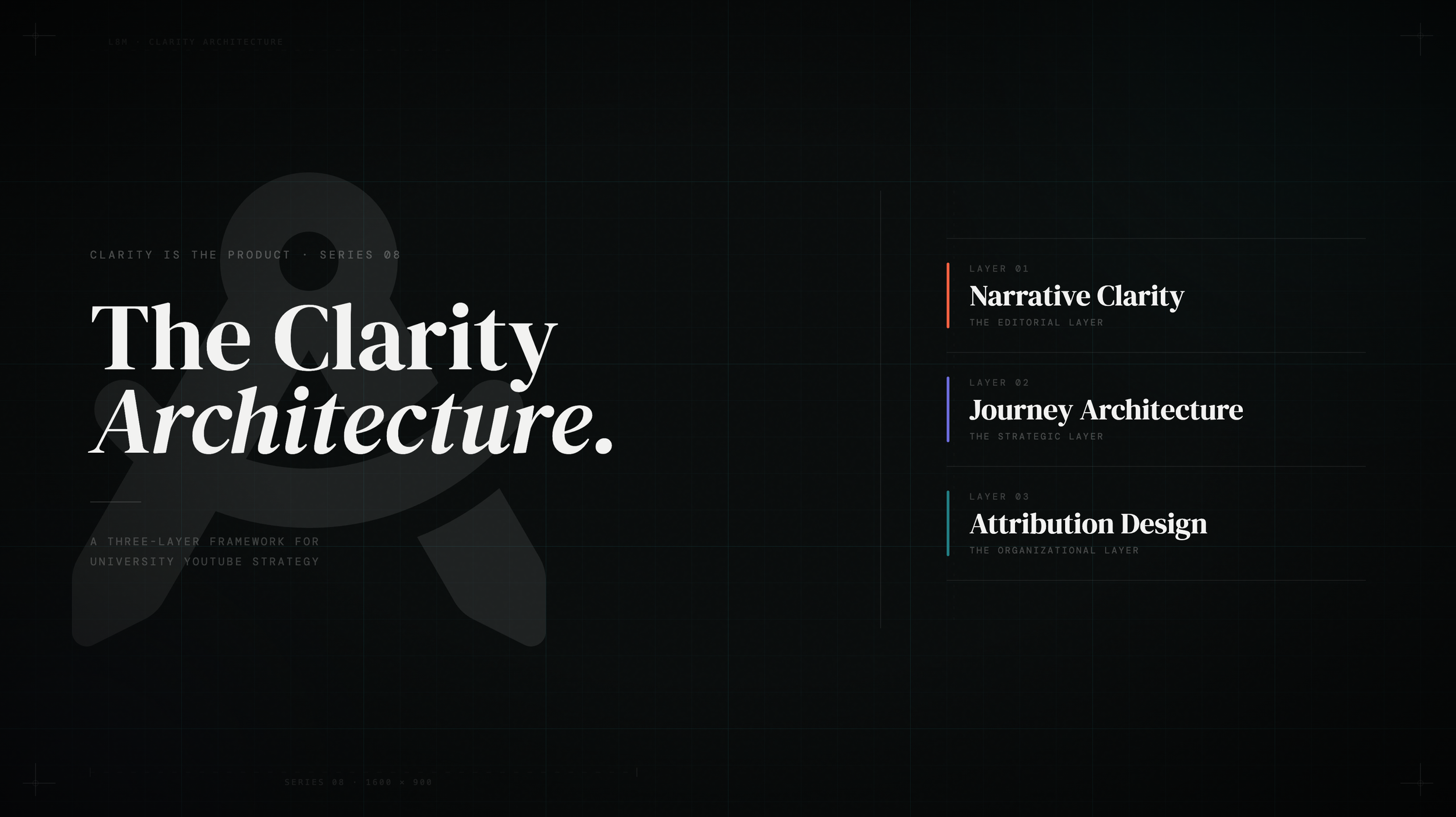
A framework for owning the narrative through-line from first impression to enrolled student.
This series started with a question about why university YouTube channels can't prove they work.
It went through the science of how educational content builds trust versus institutional content destroys it. Through the psychology of the student decision journey and why broadcast channels fail the students who need them most. Through the organizational structure that makes attribution impossible, even when the will to measure exists. Through ASU, which built the most sophisticated YouTube enrollment model in higher education and still can't trace a YouTube viewer to an enrolled degree student.
Each post named a part of the problem. This one is the answer.
Not a checklist. Not a set of platform recommendations. A framework that describes, precisely, what a university content strategy needs in order to connect what your team produces to the enrollment outcomes your institution needs, and what organizational conditions make that connection possible.
Why the existing models fail
Before the framework, the failure modes, because the framework only makes sense against what it's designed to replace.
The brochure channel is the most common model in higher education. Its organizing logic is institutional representation: show the campus, celebrate the achievements, broadcast the brand. Content is measured by views and subscriber counts. Nobody owns the question of what a prospective student is supposed to understand or do after watching. The channel exists because the institution believes it should have one, not because the institution has a clear answer for what it's supposed to accomplish.
The campaign channel is the brochure channel with a paid media budget attached. Content is organized around enrollment cycles rather than student questions. There is more strategic intent, but it's applied to the wrong level: campaign performance rather than journey alignment. The measurement improves (click-through rates, landing page conversions) without addressing the upstream question of whether the content is building the kind of trust that makes a student want to click in the first place.
The awareness channel is what most institutions produce when they've read the right frameworks but not internalized them. Content is loosely mapped to awareness, consideration, and decision stages. The problem is that this mapping is almost always institutional in its logic. Awareness content builds awareness of the institution. Consideration content describes the institution's programs. Decision content makes the case for the institution. The student's actual questions at each stage remain unaddressed because the framework is organized around what the institution wants to say at each stage rather than what the student needs to understand.
All three models share a structural defect: they put institutional communication where editorial judgment needs to be. The content is about the institution rather than for the student. And in the absence of genuine utility for the viewer, no amount of production quality, posting frequency, or platform optimization changes the outcome.
The Narrative Through-Line
A through-line, in dramatic writing, is the central thread connecting every element of a story. It gives individual scenes their meaning in relation to the whole. Without it, scenes accumulate. With it, they compound.
University YouTube channels accumulate scenes. The Narrative Through-Line is the framework for making them compound.
It has three layers. The layers are sequential, not parallel. You cannot build the second without the first, and the third without the second. This sequencing is not a design preference. It reflects how the failure actually propagates: institutions that try to solve attribution without narrative clarity, or build journey maps without editorial alignment, end up with sophisticated-looking infrastructure that produces the same unanswerable question: is this working?

Narrative clarity is the editorial layer. It defines the purpose of every piece of content in terms of what the viewer walks away knowing, rather than what impression the institution created.
The diagnostic is simple and almost universally failed. Pick any five videos on your institution's YouTube channel. For each one, write one sentence completing this: "After watching this, a prospective student now understands _______ that they didn't before." If the sentence can't be completed with a specific, testable insight, the content doesn't have narrative clarity. It has institutional presence.
What narrative clarity requires in practice is an editorial leadership function: someone who holds the question "what does the student need to understand?" above the question "what does the institution want to say?" These two questions produce different content. At most universities, the second question wins by default because nobody is holding the first one accountable.
Narrative clarity is not the same as simplicity. Complex ideas can be communicated with complete clarity. The standard is not accessibility. It is specificity: can you name, before production begins, the insight the student will carry away? If not, the content should not be produced until that question has an answer.
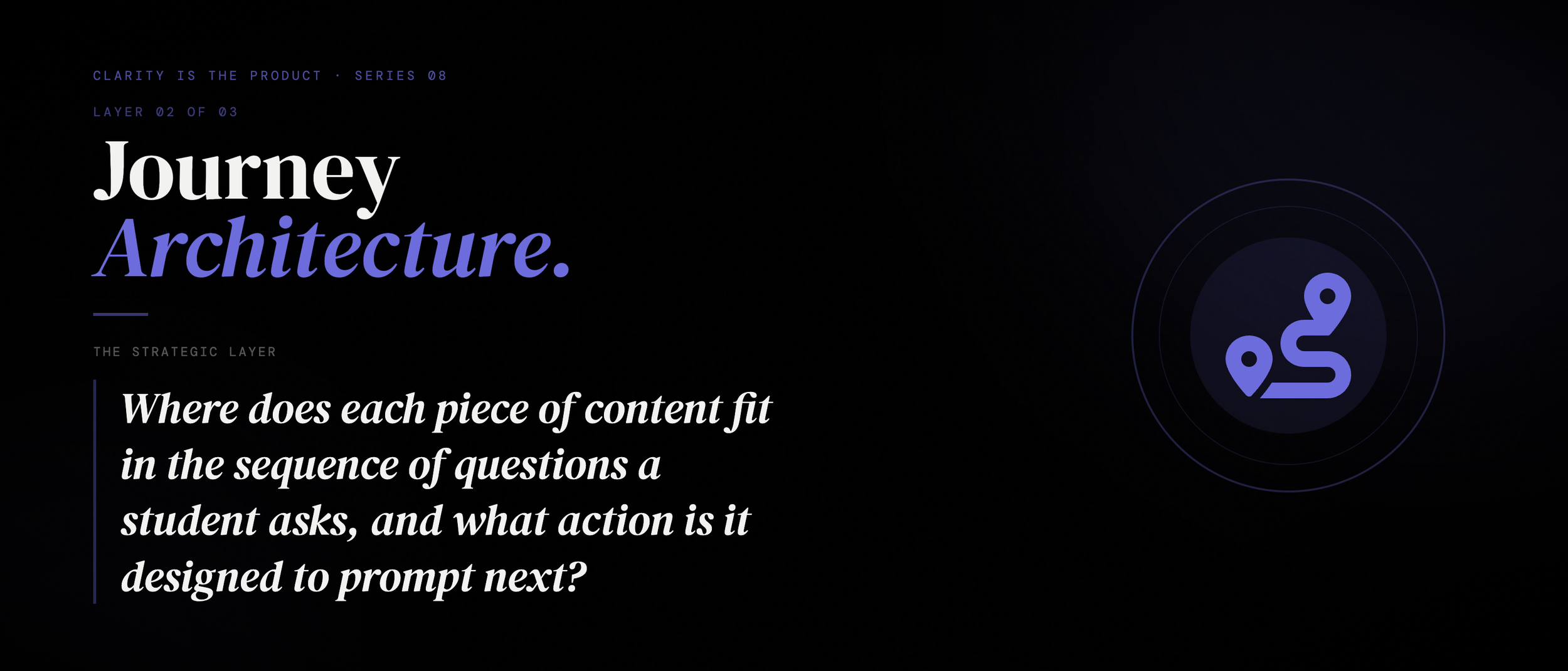
Journey architecture is the strategic layer. It maps content to the actual decision sequence of the students you are trying to reach, not to the funnel stages your agency uses or the communication calendar your enrollment team prefers.
The difference matters. A funnel stage is a description of where a student is in a process. A decision question is what a student is actually trying to resolve before they can move forward. The funnel says "consideration." The decision question says "I'm interested in your nursing program but I don't know if I'm academically prepared and I'm afraid of failing." Those are not the same thing, and they require different content.
Building a journey map starts with the questions, not the stages. The best source for those questions is not a survey instrument or a focus group. It's enrollment counselors, who hear the same dozen questions from different students week after week. It's the search queries that lead prospective students to your site before they know your program names. It's the questions asked in every campus visit Q&A that nobody has ever turned into a video.
Once the questions are mapped, content can be organized around them. Each piece gets a specific assignment: it addresses a named question at a named decision stage, and it is designed to prompt a named next action. Not "build awareness," but a specific behavior: search this program, watch this video, register for this event, request a call from an enrollment counselor.
Journey architecture is what makes content strategy coherent across a team. Without it, each content creator makes independent decisions about what to produce based on what seems interesting or timely or requested by a department. With it, the team is working from a shared map that connects every editorial decision to enrollment strategy.
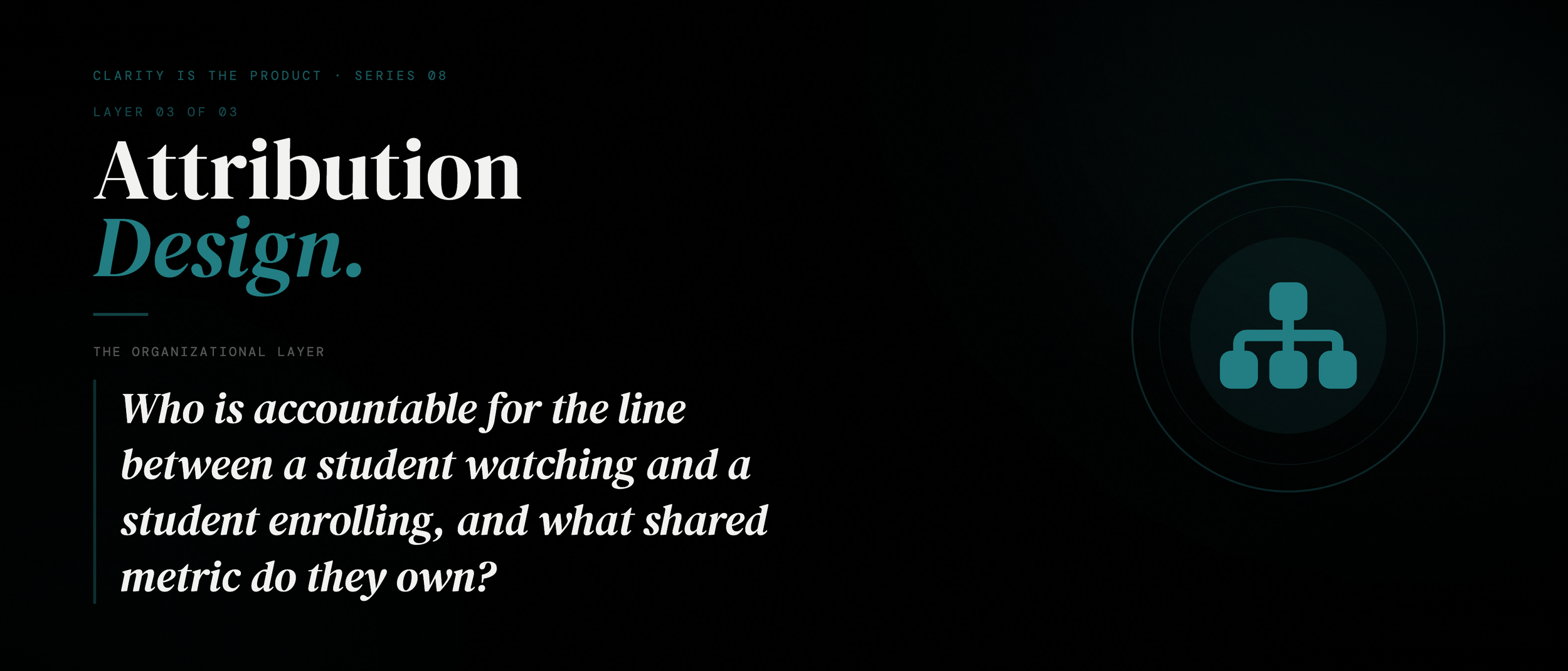
Attribution design is the organizational layer. It is the hardest layer to build and the most expensive to leave unbuilt, because it is the layer that makes the first two layers legible to institutional leadership.
Narrative clarity and journey architecture can be built by a skilled editorial function without full organizational change. Attribution design cannot. It requires cross-functional authority, shared data infrastructure, and a metric that all three teams (video, digital, enrollment) report against together.
The shared metric does not need to be perfect to be useful. It needs to be agreed upon and owned by a single function. Something like video-assisted inquiry rate: among students who submitted an inquiry, what percentage had engaged with video content in the preceding weeks? That number can be tracked with existing CRM and analytics tools at most institutions. It is not a complete picture of video's contribution to enrollment. It is a beginning that creates accountability where none currently exists.
The organizational condition for attribution design is a person or function with the authority to require the data from all three teams and the mandate to report the combined result to institutional leadership. This is the through-line owner described in the previous post in this series. Without this function, each team continues optimizing its own dashboard and the combined story never gets told.
What alignment looks like in practice
Revisiting the ASU case through the lens of this framework shows precisely where the model succeeds and where it stalls.
Study Hall has strong narrative clarity. The content is organized around what a hesitant, cost-anxious, first-generation or returning learner needs to understand before they'll risk anything: that college-level work is something they can do, that the financial barrier is lower than they believed, that failure before committing to a transcript is structurally prevented by the model. Every piece of content exists to answer a specific version of "can someone like me do this?"
Study Hall has solid journey architecture. The sequence from free YouTube content to $25 course enrollment to $400 credit purchase to Earned Admissions degree pathway is a deliberate map of the student's decision journey. Each step lowers the barrier to the next. Each step answers the question the previous step raised.
What Study Hall has not built is a functioning attribution layer. The free YouTube tier is structurally disconnected from the enrollment data. There is no through-line owner with cross-functional authority and a shared metric. The pipeline exists. The gauge does not.
This is not a criticism of ASU. It's an illustration of how hard the third layer is to build, even for an institution that understood the first two with more clarity than almost anyone in higher education. The organizational change required for attribution design is more significant than the content change required for narrative clarity. It requires institutional will and leadership commitment in a way that better editorial practice does not.
What it takes to build this
The Narrative Through-Line is not a production methodology. It does not tell you what cameras to use, how long your videos should be, or how often to post. Those decisions flow from the framework. They are not the framework.
What the framework requires is a sequence of organizational commitments.
First: name the editorial question as the primary purpose of your content strategy. Not "build brand awareness." Not "support enrollment goals." Specifically: what does a prospective student in your target population need to understand at each stage of their decision, and are you the right source for that understanding?
Second: build the journey map before building the content calendar. The journey map is a working document. It is revised as you learn more about what questions your students are actually asking. It should be owned, maintained, and used to direct editorial decisions by the function accountable for the through-line.
Third: establish the shared metric before the budget conversation. The hardest moment to install attribution design is after a budget request has already been made without it. The VP who can walk into a budget conversation with a defined metric, a baseline, and a six-month measurement plan is in a fundamentally different position than the VP defending view counts. Build the metric first. The content investment becomes defensible in enrollment terms rather than platform terms.
Fourth: locate the accountability. Who holds the through-line? If the answer requires a long explanation, the accountability isn't located. It is diffuse, which means it will evaporate the first time a competing institutional priority creates pressure. The through-line needs a name on it.
The case for moving now
The compounding advantage argument is real and it is measured. Non-brand search cost-per-click in higher education dropped 13% from 2023 to 2024. Institutions with organic video audiences built around strategic purpose are compounding their paid media efficiency. The institutions still producing brochure content are paying more to reach the same students.
The gap is not primarily about content quality. It is about strategic architecture. The institutions compounding advantage have made the organizational commitment to editorial judgment, journey alignment, and attribution accountability. They have done the harder work upstream. The content they produce is often no more expensive to make than institutional broadcast content. It is more strategically placed, more carefully aimed, and connected to a measurement structure that allows it to learn and improve.
That improvement compounds. Each semester's data informs the next semester's journey map. Each enrollment cycle's attribution data sharpens the editorial decisions. The institutions that have been building this infrastructure for three years are not three years ahead in content. They are three years ahead in strategic signal, in audience intelligence, and in the institutional credibility that comes from being able to answer the question "is this working?" with evidence rather than belief.
This series has been building toward a single recommendation: start with the questions your students are actually asking, build content that answers them in the sequence students need the answers, and install the organizational function accountable for proving it works.
That is the Narrative Through-Line. That is the Clarity Architecture.
The complete framework, with diagnostic worksheets for each layer and a guide to making the organizational case to your leadership team, is available as a downloadable resource for higher education marketing leaders.
If you'd rather talk through what it looks like at your institution specifically, a Narrative Clarity Call is thirty minutes and starts with your questions, not ours.
Clarity Is the Product is a series by lumen8.media on how organizations translate complex ideas into scalable understanding.
