
The Three Questions Every University YouTube Strategy Should Be Able to Answer
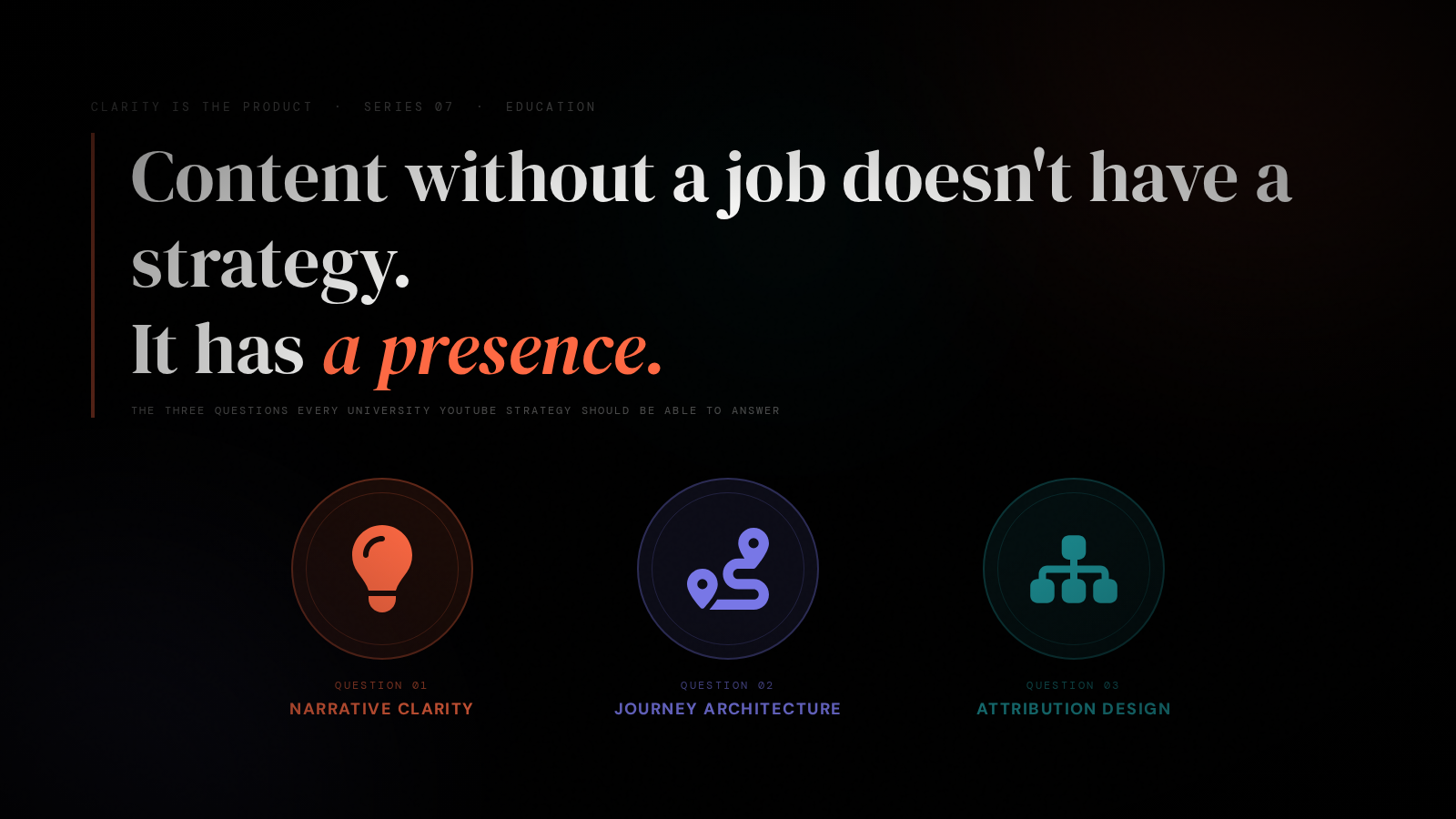
Most can't answer any of them. Here's why that's a leadership problem, and a diagnostic tool for fixing it.
Every strategic planning cycle, university marketing teams produce some version of a content audit. Views, watch time, subscriber counts, maybe a sentiment analysis. The numbers go into a slide deck. Someone in the room asks whether the channel is contributing to enrollment. The answer is usually a variation of "we believe it is" delivered with enough confidence to move past the question.
That answer is not a strategy. It's institutional inertia dressed as one.
After six posts in this series, you have a clear picture of why the attribution gap exists and what it costs to leave it open. You've seen what happens when a university builds the most sophisticated version of a YouTube enrollment pipeline and still can't close the loop. You understand the underlying organizational design problem.
This post gives you the diagnostic. Three questions that, when a VP of Marketing can answer them cleanly and completely, mean the institution has a through-line. When they can't, the channel has activity but not strategy. The distinction matters more than any platform optimization you'll run this semester.
Question One: What does a student understand after watching your content that they didn't before?
Not what impression they have. Not what emotion you created. What do they understand?
Pick any video on your institution's YouTube channel right now. Watch sixty seconds of it. Then complete this sentence: a prospective student who watched this video now understands _______ that they didn't before.
For most university channels, the honest answer is one of three things: they understand the institution is proud of itself, they understand the campus is attractive, or they understand there's an academic program called something.
None of those are understanding. They are impressions. They serve institutional reputation management. They do not close the gap between a student who is curious about your institution and a student who is confident enough to take the next step.
The channels that compound organic audiences, Crash Course, Khan Academy, TED-Ed, share a single editorial principle: every piece of content leaves the viewer with a specific, nameable insight they didn't have before pressing play. The insight is the unit of value. The retention, the watch time, and the subscriber growth are downstream of it. You cannot optimize your way to those metrics without the insight as your foundation.
This is the first layer of what a working content strategy requires: narrative clarity. Clarity about what the student needs to understand, and a commitment to making that understanding the goal of every piece of content you produce, rather than the impression the institution wants to create.
If your team can't answer the question for your five most recent videos, you don't have a narrative clarity problem. You have an editorial leadership problem.
Question two: Can you map each piece of content to a stage in the student's decision-making journey and identify the next action it's designed to prompt?
The awareness/consideration/decision funnel is a useful approximation of the student journey, and it's almost entirely useless as an editorial guide.
The reason it fails in practice is that it describes stages without describing questions. A student in the consideration phase is not simply "considering." They are asking a specific sequence of questions, driven by specific anxieties, based on where they are in their lives and what alternatives they're comparing. A 17-year-old first-generation student from a mid-size city is asking different questions in a different order than a 29-year-old working professional considering an online graduate program. The funnel flattens both of them into "consideration."
A working journey map doesn't start with the funnel. It starts with the questions.
What does a student ask before they've ever heard of your institution? What question, once answered, makes them curious enough to look further? What is the specific piece of doubt that stops a high-intent student from submitting an application? What would a video need to address to remove that doubt?
Those questions have answers. They're findable through enrollment counselor interviews, through the search queries that bring students to your site, and through the questions asked at every campus visit. Most institutions have this data somewhere. It's almost never organized into a map used by a content team to make editorial decisions.
Journey architecture is the second layer: content that maps to the actual sequence of a student's decisions, not the institution's preferred narrative arc, in which each piece earns the student's next question rather than broadcasting the institution's next message.
The test is specific. For every piece of content on your channel, you should be able to name the decision stage it addresses and the action it's designed to produce. Not "build awareness." A specific action: search our graduate programs page, sign up for an information session, watch the next video that answers what you're probably wondering now. If you can't name it, the content doesn't have a job. It has a presence.

Question Three: Who in your organization is accountable for the line between a student watching and a student enrolling, and what shared metrics do they own?
This is the hardest question. It's hard not because the answer is complex, but because in most universities the honest answer is: nobody.
The video team is accountable for watch time. The digital team is accountable for traffic. The enrollment team is accountable for yield. Nobody is accountable for the sequence connecting those three outcomes, which means nobody is accountable for the strategy the sequence is supposed to represent.
Attribution design is the third layer. It requires three things that most universities currently treat as separate concerns.
First, a shared metric that everyone agrees measures what actually matters. Not views for the video team, traffic for digital, and applications for enrollment. A metric that crosses all three: something like video-assisted inquiry rate, or content-engaged student yield, or a version of last-touch attribution that traces enrollment outcomes to specific content touchpoints. The exact form depends on what systems an institution has and what integrations are possible. The principle doesn't: there needs to be one number that one person owns that answers whether the content strategy is working at the level of enrollment, not platform.
Second, shared data. The free YouTube tier of most university channels is analytically isolated from the CRM where enrollment data lives. That gap is not inevitable. It's a choice, made by default, because no one has been given the authority or the mandate to build the bridge. Someone with cross-functional authority can require the integration. Without that authority sitting somewhere specific, each team continues to optimize for its own dashboard, and the through-line remains invisible.
Third, the willingness to act on what the data reveals. This is where organizational inertia is most expensive. When content that performs by vanity metrics can't be connected to enrollment outcomes, something has to change: either the content, the measurement methodology, or the organizational expectation. That decision requires a mandate and a leader who holds it.
Why the order matters
These three questions aren't parallel. They're sequential, and the sequence is not arbitrary.
You cannot design a useful journey map without narrative clarity. If you don't know what each piece of content is supposed to help a student understand, you cannot map that content to a decision stage with any precision. You're organizing confusion, not strategy.
You cannot build meaningful attribution design without a functioning journey map. If you haven't defined what content belongs where in the student's decision, you have no baseline against which to measure. Attribution without journey architecture produces numbers that feel meaningful and aren't.
This is the exact failure mode that makes the ASU case instructive. Study Hall has narrative clarity. The content is designed around what a hesitant learner needs to understand, not what ASU wants to broadcast. It has the architecture: a structured sequence from free access to paid course to earned credit to degree admission. What hasn't been fully built is the attribution layer, the organizational design that traces a YouTube viewer through that entire sequence and produces an accountable number. The first two layers without the third is a pipeline without a gauge. You know it's flowing. You can't prove how much.
Most university channels are missing all three layers. Some have a partial version of one. Very few have even one layer cleanly built. None of this is a content problem.
What the framework is called
These three layers, narrative clarity, journey architecture, and attribution design, are the structure of a framework called the Narrative Through-Line.
The name is precise. A through-line, in theatre and screenwriting, is the central thread that connects every element of a story and gives individual scenes their meaning in relation to the whole. When a through-line is present, even a brief scene in a complex narrative lands with weight because the audience carries the context. When it's absent, scenes accumulate without adding up to anything.
University YouTube channels produce scenes. Most don't have a through-line. The scenes are individually competent, occasionally excellent, and strategically incoherent. The student who watches three of them doesn't leave with a clearer picture of whether this institution is right for them. They leave with more impressions.
The Narrative Through-Line framework gives a VP of Marketing a language and a structure for the conversation that the "is this working?" question has been fumbling toward. It names what's missing, describes what it looks like when it's present, and provides the diagnostic to close the gap.
The next post in this series is the full framework: what it looks like at each layer, what a good implementation requires, and what the institutions that build it correctly have in common. If you want the complete framework as a working guide before then, we've built it out as a downloadable resource for higher education marketing leaders.
Download The Clarity Architecture at lumen8.media.
Clarity Is the Product is a series by Lumen8 Media on how organizations translate complex ideas into scalable understanding.
