
Series 11 · Technology | Lumen8 Media By Michelle Lanier Reid
This post is the companion to Series 10: Never Been Confused. That post made the mechanistic case for why AI content cannot replicate the cognitive states that make educational content work. This one makes the relational case.
In 2009, I was at the first TEDx Phoenix.
I was working at the University of Phoenix at the time, deep in research into which types of media actually facilitate understanding, particularly in distance and online learning. I had already started to develop an intuition about how learning works: that something about failure, about being wrong first, seemed to be the engine of real comprehension. I just didn't have the language for it yet.
During the event, they showed Mike Rowe's TED talk in its entirety. The one about dirty jobs. The one with the sheep.
I should tell you: I love animals. I have a deep aversion to animal cruelty. Which means I was exactly the kind of person who would have read the PETA-recommended pamphlet, accepted its guidance without question, and never found myself anywhere near a sheep farm to discover that the "humane" method causes days of sustained suffering. I was precisely the pamphlet reader. I would have been wrong and never known it.
What stopped me in my seat wasn't the graphic reality of the sheep farm. It was two Greek words Rowe pulled from Aristotle.
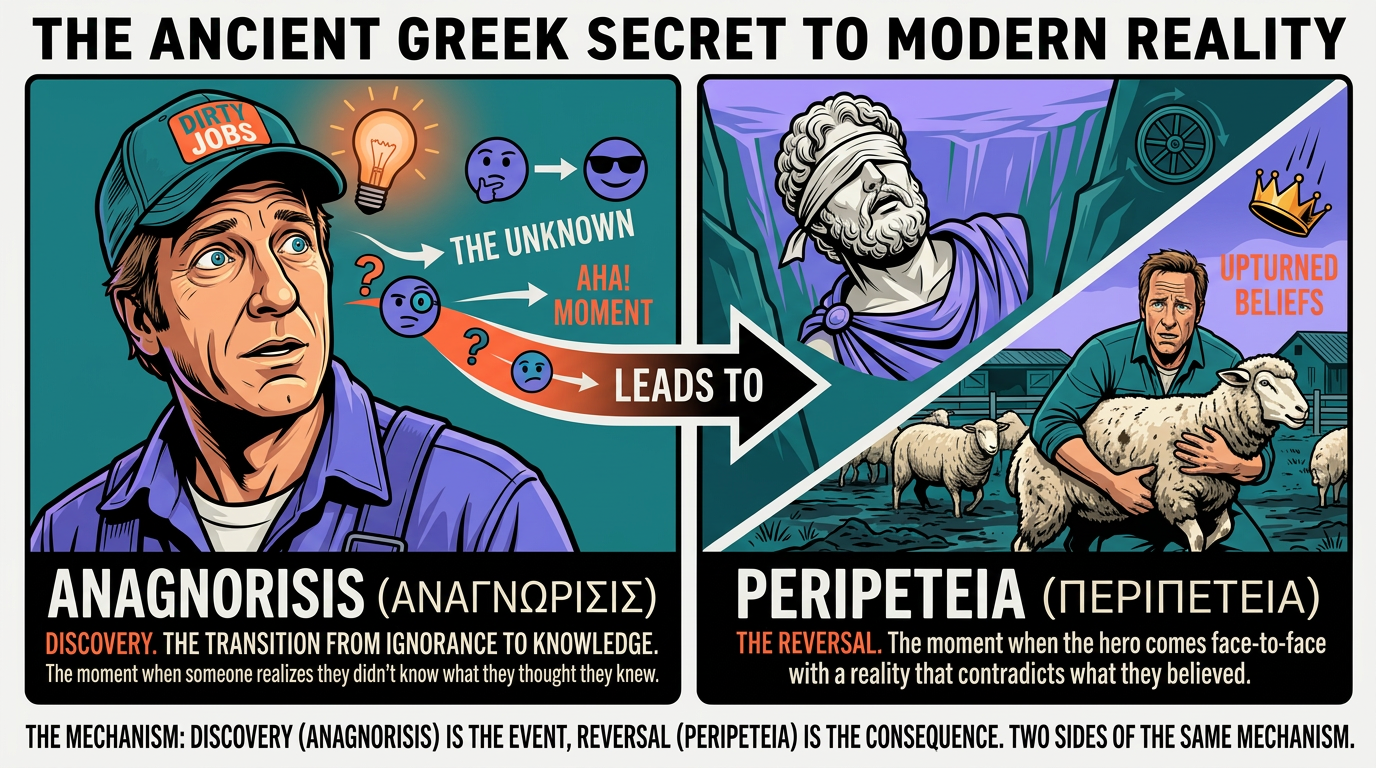
Anagnorisis: the transition from ignorance to knowledge. Literally, the Greek word for discovery. What Dirty Jobs does, Rowe explains, is put someone in a situation where they discover they didn't know what they thought they knew.
Peripeteia: the reversal. The moment when the hero comes face-to-face with a reality that contradicts what they believed. Oedipus is Aristotle's dramatic example. The sheep farm is the practical-world version.
The two are a pair. Anagnorisis is the discovery event. Peripeteia is the reversal that follows from it. You can't have the reversal without the discovery, and the discovery only matters because it overturns something. They are two sides of the same mechanism.
Sitting in that auditorium, I experienced both at once. I had an anagnorisis; I suddenly had language for something I'd been circling for months in a research context. And that discovery caused its own peripeteia: my understanding of how learning works reversed from abstract academic intuition to something I could see demonstrated in the salt-of-the-earth reality of a sheep farm. There it was, in the most practical terms imaginable, this truth about how humans learn, and why failure is not an obstacle to that process but the engine of it.
I've spent the past 15 years building content around that structure. What I didn't fully understand until recently is why it works, not just narratively, but neurologically and psychologically. The research is unambiguous and points to something with significant implications for anyone building educational content right now.
Mike Rowe arrived at the sheep farm having read the briefing. The PETA-recommended method for castrating lambs uses a rubber band: clean, institutional, credentialed. He handed the farmer the kit. The farmer set it aside and used his teeth instead.
Rowe was horrified. Then he learned that the rubber band method causes several days of sustained suffering. The traditional method takes seconds. The pamphlet was produced by a credentialed organization with genuine care for animal welfare. It was confidently, systematically wrong. And there was no way to know that without being in the barn.[1]
This is the opening of a TED talk with 7.3 million views. It is not a talk about sheep. It is a demonstration, in real time, of the only structure that has ever reliably transferred understanding from one person to another: someone who was wrong, then wasn't, taking you through what that reversal felt like from the inside.
What Aristotle Called It
Mike Rowe's talk has a chapter titled "Peripeteia." He didn't choose the word casually. Aristotle used both terms, anagnorisis and peripeteia, in Poetics to describe the paired movements at the heart of great narrative. Anagnorisis is the discovery: the moment a character transitions from ignorance to knowledge. Peripeteia is the reversal that follows: the situation turns on that discovery in a way that cannot be undone. Aristotle considered them inseparable. The discovery without the reversal is just information. The reversal without the discovery is just a shock. Together, they are the structure of learning.
Nancy Duarte spent years analyzing the structure of the most impactful speeches and presentations of the last century and found they share the same spine: an oscillation between what is and what could be, with the peripeteia at the center.[2] The moment of reversal. The moment the speaker was wrong. Without it, the talk is a lecture. With it, it becomes an experience the listener participates in.
TED's format did not invent this structure. It was selected for it. The talks that spread did so because they contained that moment. The format is proof of concept at scale. Trust Is Not the Setup. It's the Mechanism.
Trust Is Not the Setup. It's the Mechanism.
Educational psychology has spent decades measuring what actually drives learning. John Hattie's Visible Learning synthesis of over 800 meta-analyses on student achievement found that the teacher-student relationship has an effect size of 0.72, well above the 0.40 threshold representing one year of learning growth. Teacher credibility scores higher still: 0.90.[3]
That number matters because of what credibility actually is. It is not a credential. It is not a title. Hattie's data shows it is built through observable actions: consistency, fairness, and demonstrated honesty about the limits of one's knowledge. In other words, the teacher who has shown you they can be wrong is more trusted than the teacher who hasn't, and the more trusted teacher produces more learning.
The mechanism that explains this was formalized by psychologist Elliot Aronson in 1966. His research found that highly competent individuals who reveal a minor flaw are trusted more than those who present as flawless. Attractiveness scores increased by nearly ten points when a competent person made a visible mistake, and decreased when a less competent person made the same mistake.[4] Revealed imperfection in someone who demonstrably knows what they are doing reads as honesty, not weakness. The pratfall, counterintuitively, is what makes authority believable.
Peter Fonagy's research at UCL extends this further. His work on epistemic trust argues that human beings are calibrated to learn from people they trust, and that this trust is established not through credentials but through mentalizing, the felt sense that the other party is thinking about your mind, your experience, your confusion.[5] When that sense is present, we open ourselves to being changed by what we hear. When it is absent, we receive information. But receiving information and having understanding reorganized are different events, and only the second one produces lasting change in behavior.
Why Reciprocity Is the Whole Point
When Brené Brown opens the most-watched TED talk in the format's history by describing how her own research broke her. She spent a year trying to systematize vulnerability away and ended up in therapy. She is not performing humility.[6] She is establishing the conditions under which learning can happen.
Her peer-reviewed research on shame resilience found that vulnerability creates the conditions for connection precisely because it invites reciprocity.[7] When a speaker says I was wrong about this, and here is what that cost me, the listener is given permission to acknowledge where they are also wrong. The confession is an invitation. The failure arc is the mechanism by which the listener's defenses lower enough for understanding to move in.
Why AI Breaks This at the Root
Series 10 of this series made the mechanistic case: AI has never been confused, so it cannot produce the specific epistemic authority that comes from genuine confusion followed by genuine resolution.[8]
The trust argument runs deeper. Fonagy's framework requires mentalizing: the felt sense that the other party is thinking about your mind. AI has no mind from which to think about yours. It has no stake in whether you understand; nothing changes for it if you leave the interaction more confused than when you arrived. There is no reciprocity available because no party is capable of genuine vulnerability.
This is the wall that parasocial learning research keeps encountering. A 2022 study in Frontiers in Education found that parasocial relationships with video educators increase learning motivation but showed no correlation with actual learning growth.[9] Motivation and transfer are different mechanisms. Motivation gets you to the barn. Transfer happens inside it, with someone who has actually been wrong about what they're teaching, taking you through what it felt like to arrive on the other side.
AI can generate content that increases motivation. It can produce material that is well-organized, clearly presented, and useful as a reference. What it cannot produce is a speaker who had something at stake in being wrong, who found out, and who is now standing in front of you carrying the specific authority of someone who has been through the peripeteia. The reversal. The moment when what they thought they knew collapsed.
That is not a quality difference between AI content and human content. It is a structural one. The mechanism is either present or absent, and when present, it requires a subject who has experienced something.
The Question Your Content Needs to Answer
Before your next piece of educational content: where is your failure arc? Treat it as the structural mechanism it is, the load-bearing element, not decoration.
Where did you think you understood this, and how did you find out you didn't? What did the correction cost you? What is different about how you approach this now compared to before that cost was incurred?
If you cannot identify it, the content may still be correct. It might be well-organized and clearly communicated. However, the trust mechanism lacks a starting point; the listener has nothing to give back, and Hattie's data indicates that, in such cases, you only get engagement without any reorganization: information is received, but nothing is altered.
Mike Rowe stood in a field and watched a farmer do something that looked wrong. He'd read the pamphlet. He was prepared. He was wrong in a way the pamphlet could not have prepared him for. He stayed, he watched, and he learned.
That is the content worth making.
Not the pamphlet. The barn.
Citations
[1] Rowe, Mike. "Learning from Dirty Jobs." TED, YouTube, 2008. https://www.youtube.com/watch?v=IRVdiHu1VCc
[2] Duarte, Nancy. "TEDxEast — Nancy Duarte Uncovers Common Structure of Greatest Communicators." TEDx Talks, YouTube, November 2010. https://www.youtube.com/watch?v=1nYFpuc2Umk
[3] Hattie, John. Visible Learning: A Synthesis of Over 800 Meta-Analyses Relating to Achievement. Routledge, 2009.
[4] Aronson, Elliot, Ben Willerman, and Joanne Floyd. "The Effect of a Pratfall on Increasing Interpersonal Attractiveness." Psychonomic Science, 1966. https://link.springer.com/article/10.3758/BF03342263
[5] Fonagy, Peter, and Elizabeth Allison. "The Role of Mentalizing and Epistemic Trust in the Therapeutic Relationship." Psychotherapy, 51(3), 372–380, 2014.
[6] Brown, Brené. "The Power of Vulnerability." TED, YouTube, 2010. https://www.youtube.com/watch?v=iCvmsMzlF7o
[7] Brown, Brené. "Shame Resilience Theory: A Grounded Theory Study on Women and Shame." Families in Society, 87(1), 43–52, 2006.
[8] Lanier, Michelle. "Never Been Confused: Why AI Can Scale Information But Cannot Scale Understanding." Lumen8 Media, Series 10, 2026. [lumen8.media/series-10]
[9] "The Influence of the Parasocial Relationship on the Learning Motivation and Learning Growth with Educational YouTube Videos in Self-Regulated Learning." Frontiers in Education, 2022. https://www.frontiersin.org/journals/education/articles/10.3389/feduc.2022.1021798/full
